What is the difference between Round and Square Linear Guides
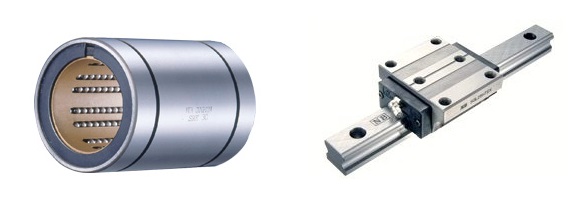
Linear motion systems play a pivotal role in ensuring precision and stability in machinery and equipment. Both round and square linear guides serve as the backbone of accurate linear motion within guide rails, yet each possesses unique characteristics tailored to specific applications. This article explores a comprehensive comparison of round and square linear guides, shedding light on their attributes, advantages, and applications in the field of linear guide systems.
Round Linear Guides
Round linear guides, often referred to as ball bushings, have been a stalwart in linear motion technology for over 80 years. This older technology is designed to enable precise and controlled linear motion within various guide rail systems. While round guides may have a lower load capacity and looser accuracy, they offer an economical option for applications without critical tight tolerances.
The circular nature of ball guides facilitates even load distribution, similar to cylindrical rollers in roller bearings. This attribute ensures smooth and consistent motion, making round linear guides suitable for specific applications requiring uniform movement between guide rails and rolling elements.
Square Linear Guides
Square linear guides, also known as profile rails, represent a newer and more efficient solution in mechanical engineering, having been utilized for 40 years. Unlike their round counterparts, profile rails excel in strength, providing robust support for heavier loads. The rectangular track design enhances stability, making square linear guides ideal for applications demanding structural integrity and precise performance.
Linear guide rails, in general, maintain accuracy and repeatability, but square linear guides stand out where rigidity and precision are paramount. The square geometry ensures these guides can handle high loads consistently and accurately.
Comparison of Round & Square Linear Guides
Surface Contact
Profile Rails: Feature a rectangular track design, providing larger surface contact for rolling elements and guide rails. Optimized for a wider range of load-bearing capabilities and mounting forces.
Round Linear Guides: Employ a circular track, offering uniform contact between rolling elements and guide rails. Slightly lower load support but delivers smoother motion.
Linear Motion Precision
Profile Rails: Inherently resistant to forces due to their rectangular track, ensuring accurate and repeatable linear motion. Ideal for high-demanding accuracy industries like CNC machining and semiconductor machinery.
Round Linear Guides: Lower precision compared to profile rails but offer more flexibility. Circular design provides consistent and smoother movement under certain conditions.
Applications
Profile Rails: Commonly used in heavy-duty applications requiring robust load-bearing capacity, such as industrial automation machine tools. Suitable for environments demanding accuracy with heavy loads.
Round Linear Guides: Versatile and compact, fitting well in limited space scenarios and aesthetic-sensitive applications. Examples include electronic assembly or medical industry machines.
Rigidity and Stiffness
Profile Rails: Feature higher resistance to deflection of torsional forces, providing greater rigidity and stiffness for accurate motion, even in demanding environments.
Round Linear Guides: Exhibit lower stiffness due to the circular track, resulting in lower load-bearing capacity. May be affected under harsh or heavy loads.
Installation and Flexibility
Profile Rails: Straightforward installation regardless of rail length, offering various mounting options. The rectangular profile allows flexibility, especially in existing equipment with spatial constraints.
Round Linear Guides: Compact design reduces friction, providing flexibility and simpler installation. Offers less mounting variety compared to square guides.
Conclusion
In conclusion, the choice between round and square linear guides depends on specific application requirements. Round guides excel in versatility and cost-effectiveness, while square guides offer strength and stability for heavy-duty applications demanding precision. Understanding the unique attributes of each guide is crucial for making informed decisions in the world of linear motion systems.
HVH Industrial Solutions is an authorized distributor of Thomson Linear, IKO, Schneeberger, Nippon Bearing, and many others. We work closely with their engineering team to provide superior customer service and engineering support.
If you have any questions, write to us via live chat or call or send us a quote request. The HVH team is always ready to help you
Requesting ...
File size should not exceed 20 MB.
Are you sure you want to delete file?